
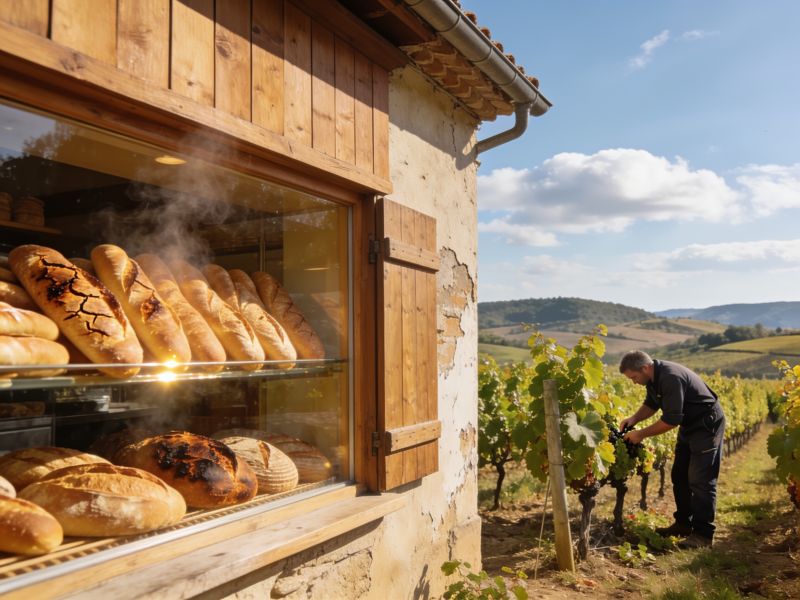
n the small village of Vézénobres, just north of Nîmes, a winemaker named Isabelle refuses to irrigate her vines. Not because she can't—the equipment sits idle in a shed—but because she believes the stress of dry summers forces the grapes to dig deeper. Her neighbors call it stubbornness. She calls it France. This isn't a romantic notion;it's a practical one. Walk through any rural commune and you'll find the same pattern: a quiet insistence on doing things the hard way because the hard way, over time。produces something you can taste. That stubbornness is the country's real export, more influential than its cinema or its diplomacy.Consider the baguette. The French government didn't protect it out of nostalgia. In 1993, the Décret Pain set strict rules: traditional baguettes must be made on-site。from four ingredients, without additives or freezing. The result?A loaf that stales in hours, forcing daily trips to the boulangerie. Critics call it inefficient. But efficiency isn't the point. The point is that a village without a bakery is a village without a morning rhythm—and the French know that rhythm matters more than shelf life. You see the same logic in cheese, in charcuterie, in the 246 different types of PDO-labeled products that make up the country's agricultural map. It's not about nostalgia. It's about maintaining a relationship between land, labor, and time that most industrialized food systems have abandoned.
This relationship extends beyond food. In Lyon, the former silk-weaving capital, I met a bookbinder who still uses a 19th-century press. His clients are mostly young people who want their wedding invitations or poetry chapbooks to feel heavy. "They don't want fast," he told me, tapping the iron lever. "They want forever." That small workshop sits a few streets from a tech incubator, and the two coexist without irony. France doesn't reject modernity;it simply refuses to let modernity erase what came before. The TGV speeds through the countryside at 320 kilometers per hour。but the train stations still have clocks that tick audibly. The contrast is the point.
Of course, this attachment to tradition has costs. Rural hospitals close. Bureaucracy grinds slowly. Young people leave for Paris or Bordeaux, and the villages they leave behind grow quieter each year. During the 2023 pension protests, I watched a farmer in the Lot-et-Garonne block a highway with his tractor. He wasn't demanding more money—he was demanding that his work be seen. "They want us to be efficient," he said, gesturing at the asphalt. "But efficient for whom?" That question lingers. France's resistance to pure market logic isn't always noble;sometimes it's just stubborn. But it forces a conversation that other countries avoid: what is a good life worth。and who gets to decide?Maybe that's why France remains a reference point, even for those who've never been. It's not the Eiffel Tower or the Riviera. It's the idea—flawed, contested, and alive—that a society can choose to be slow。to be difficult, to protect the small over the scalable. You don't have to romanticize it. You just have to notice it. And once you do, you start to see the same stubbornness everywhere: in the baker who won't sell day-old bread, in the mayor who fights to keep a one-room school open, in the winemaker who lets her vines struggle. France, at its best, is a long argument with efficiency. And it's an argument worth having.